This is a teaching integractive blog. On Sundays, I usually write an essay about elements that influence my teaching or that are related with my teaching. What I am going to write about today has influenced me deeply both as person and as teacher: my faith. I usually do not talk about my faith in my classroom, but today I am going to talk about a faith experience that has helped me to model the kind of person and teacher I want to be.
Today I am going to write about how I overcame a deep faith crisis that leaded me to become a better person and a better teacher.
Several years ago, around 2008, I had a deep and strong faith crisis. I asked myself if I could be creative and catholic at the same time, if I could be who I am (I am naturally intellectual and creative) and catholic at the same time. This crisis was caused by my belonging to a catholic institution, still quite unknown in Puerto Rico, called “Opus Dei”. This institution teaches through intern institutional formation that if you leave them you lose your vocation and probably even your eternal salvation, among other very questionable teachings.
Through this crisis I discovered my true vocation, my human and ecclesial vocation, my vocation to grow by living charity and to irradiate God’s Love by forming Him in my whole personal formation. I deepened my human and ecclesial vocation through three ways:
-Though Arts: I painted a Jesus Charity. The picture of that painting is this one:
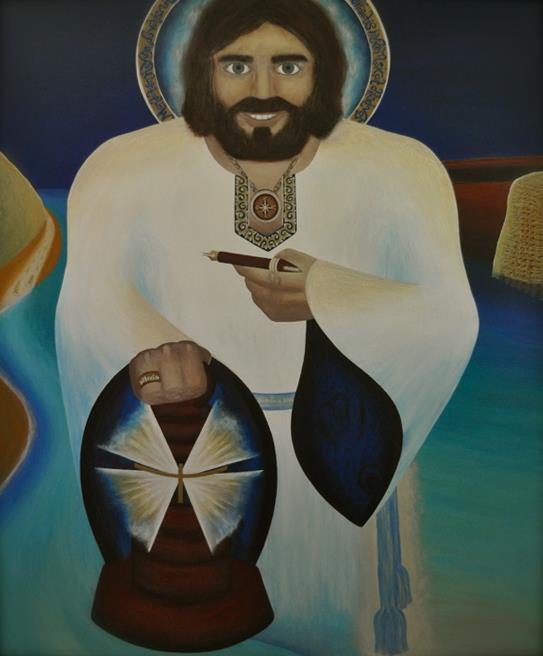
I developed an iconography for all the forms included in the painting. I also wrote a love story that described my process of conversion after leaving Opus Dei: Fiat Amor. I affirmed my ecclesial vocation as a vocation to form an image of God’s Love in whole personal formation through living charity. My vocation stopped being an “institutional vocation” (belonging to Opus Dei) to be transformed in a personal vocation, humanly and ecclesially. I discovered my vocation as fruit of God’s grace, not as fruit of institutional proselytism (like in Opus Dei). I discovered my creative talent as an instrument the Church, instead of being something that hindered some institutional customs.
-Through Sciences (Humanities, Education, Social Sciences, Philosophy): I created integraction, a model of human and ecclesial personal formation. Formation stopped being institutional (aspiring to be Opus Dei) to become in personal formation, humanly and ecclesially. I discovered personal formation as charism, instead of some kind of institutional “mold”. I discovered intellectual talent as instrument to affirm my whole personal formation according to God’s Love, not according to the customs of an institution.
-Through Religion (Catholic theology): I created a theology of light, a theology that deals with the whole personal formation according to God’s Light, a theology that proposes the personal formation as the fullest radiation of God’s Love. I discovered theology as contemplative knowledge of God’s Love, not as memorization of information only, as I knew it in Opus Dei. I discovered the personal formation as talent to serve humanity, not as instrument to serve an specific institution only.
My healing and my restoration after my belonging and leaving Opus Dei has taken long years, more than the time I belonged the institution. In part it had to do with the fact that before I met Opus Dei I was a person of faith with common elements with the institution. For example, prior entering Opus Dei I had a clear lay vocation and thought that studying philosophy and theology was part of my God’s call. That is to say, in my vocation there were elements common to Opus Dei prior belonging to them, without the institution being the one to propose it, hence I really thought that my vocation to Opus Dei was real.
Once restored, my human and ecclesial vocation was transformed, after a time of living it as an “alliance of charity”, into a “consecration to charity”: a consecration to learn how to live charity with the greatest possible correspondence to God in all circumstances; a consecration to learn how to walk like Jesus walked, to think like He thought, to act like He acted, to grow as He grew, to radiate like He radiated, to love like He Loved… to live like He lives. The consecration to charity is a service to people and to the Church. It is difficult to describe the immense joy that comes from the simple fact of being able to live and form myself based on living charity, something so deeply ecclesial and Christian, after surviving an experience like having belonged to Opus Dei, something that requires following so many institutional customs that are quite questionable from the charity perspective. That consecration to charity made and continues to make a big difference in me.
What kind of differences has the alliance of charity and the consecration to charity made in my personal formation? I will sketch some of them.
In negative:
–Stop forming myself as I am not: after the alliance of charity and the consecration to charity any attempt to control conscience via spiritual direction is impossible. I am no longer formed to be an institution: I am formed to be a Christian person, to radiate the image of Jesus Charity through my personal formation because I have been created to radiate that Love, that is how I am.
–Stop forming myself because “I must be in a certain way“: after the alliance of charity and consecration to charity, I began to form myself to relate personally to God, not because I must be in a certain institutional way, or not because I must be a canonized saint… The first thing is to relate to God, and everything else will come in addition to that.
–Stop forming myself to obey only: after the alliance of charity and consecration to charity, I did not form myself to fulfill a plan of life that seemed more like a marketing plan, or to fulfill the expectations of an institution. Now I am formed to grow in communion, to fulfill a project of communion, humanly and ecclesially.
–Stop forming myself to please a director: now I am not formed to please others, but to live charity towards God, towards my neighbor and towards myself. Now spiritual direction is part of living charity towards God, not merely following instructions and institutional customs.
In positive:
–Personal formation centered on personal growth, on imitating Jesus, on communion and on living charity: after the alliance of charity and consecration to charity, I am responsible for my growth, because growth no longer depends exclusively on obeying to an institution. After the consecration to charity, I discern my project of evangelization with creative freedom, imitating Jesus, growing in communion and learning to live charity. I choose the meaning of the forms of my personal and ecclesial formation.
–Acceptance of personal formation as a unit of processes: personal formation in Opus Dei is confused with institutional training that consists of memorization of information and following some customs and institutional instructions. A great change after the alliance of charity and the consecration to charity has been to accept personal formation as a unit of processes in constant progress. There is no longer the anxiety of having to adapt my whole personal formation to the foundationality of an institution. Now the personal formation is fluid and changing. Today I do not have to be the same as yesterday (I no longer have to adjust to being just Opus Dei in the same way day by day, as the directors say). The ways of living the obligations that the consecration to charity entails change day by day according to personal discernment, I do not live the charity of it in exactly the same way every day, although the commitment of consecration to charity remains the same. The consecration to charity is a flowing commitment, like the grace that flows.
–Acceptance of personal formation as a complex process: now that personal formation does not equals institutional formation, after the alliance of charity and the consecration to charity, forming myself does not consist of something as “squared” as obeying the director and following a plan (I continue living piety norms, but with freedom to be who I am. For example: if I cannot do a piety norm, I substitute it with a work of charity, and if doing a work of charity prevents making a piety norm, I do the work of charity first). Now personal formation is something complex in which elements such as natural law and experience are taken into account, and in which there can be various ways of following the will of God as inspired by the Holy Spirit.
–Openness to experience: when I was part of Opus Dei I was told many times that I had the chronic defect of being “pride” for taking into account my experience as one of the criteria of my formation. In Opus Dei the only acceptable criterion of institutional formation is the will of the director. After the alliance of charity and the consecration to charity I can freely accept my experience as part of the configuration of the criteria of my personal formation, without being treated like an “unfaithful”. Now I can open myself to experience, my own and from others, without it meaning something like wanting to oppose some institutional view.
–Acceptance of others without pretending to change them: in Opus Dei there is a huge preassure to make as many as possible part of the institution, making contact lists and determining institutional goals if necessary. This is institutional proselytism. After the alliance to charity and the consecration to charity there is no longer a desire to change others, but to help them to be, to do, to grow and to radiate. Now there is eagerness to learn to help others grow, accepting the person unconditionally.
–Acceptance of myself: Opus Dei instills mistrust in oneself, since the criterion of personal formation must always be the director. After the alliance of charity and the consecration to charity I recovered a healthy confidence in myself, with the help of God’s grace.
–Acceptance of all personal formation as it is, not according to the institution says it is: after the alliance of charity and consecration to charity I pay more attention to what is as it is. That sounds like tongue twisters, but it is not the same to pay attention to what is supposed to be according to the institutional, or to be less than what one is, to simply pay attention to what it is. For example: I now accept the personal formation of others as it is, not because of institutional proselytism.
Although I stayed studying in an Opus Dei’s University after leaving the institution, eventually I also needed to leave the University in order to be able to begin Jesus Charity as creative project and to reform my spiritual life after leaving the institution. It was impossible for me beginning Jesus Charity in their University: I did not have all the necessary intellectual resources (I lacked social sciences intellectual resources) and the necessary creative-spiritual space to begin a project like Jesus Charity there. So, I asked myself then, in what I would work after leaving my PhD in philosophy (that meant that I would not be able to become a college professor, as I planned)? I chose to become a teacher, first a religion teacher and later an ESL teacher. I chose to learn how to help people be, do, grow and radiate through school education.
How to share all my human and ecclesial growth after the alliance of charity and the consecration of charity? First, through my personal formation, through living charity and keep growing until becoming who I am and who I am meant to be according to God’s Love. However, in order to being able to do that I discerned that I needed to create an intellectual structure for reforming everything that needed to be corrected in me after leaving Opus Dei, so I began to write Walking Like He Walked, a draft in which I describe integraction, the iconography of Jesus Charity, the theology of light and the consecration to charity. I first wrote Walking Like He Walked to be shared anonymously in a web page managed by an ex Opus Dei member where ex-members of Opus Dei are usually understood (it is very hard to find spaces, specially in the Church, where people can understand the experience of surviving Opus Dei), but the administrator of that web page kindly rejected to publish my text because the web page did not want to promote any doctrine or “way” to Opus Dei ex members, and they considered my text to be a “way”. The intention was sharing this text as an anonymous “fraternal correction” to Opus Dei. What do I mean with this? Anyone who belonged to Opus Dei knows what they understand as “fraternal correction”: an accusation to which a “thank you” had to be answered always, even if it was unfair. During the final stages of my psico-spiritual recovery I discerned that I should make a fraternal correction to Opus Dei for every institutional mistake I witnessed, but the fraternal correction that I prayed was not like theirs: mine was like “helping to grow”, not like an accusation. So, according to my prayer, my fraternal correction should consist in sharing with them how much I grew while being informed, conformed, transformed and reformed by God’s Love after leaving Opus Dei, not in sharing a list of all the mistakes that I witnessed while I was linked to Opus Dei.
Anyone could ask me: how do I live charity towards Opus Dei without telling the mistakes I witnessed? Simply: avoiding condemning anyone, including them. In this case, living charity is allowing everyone to grow, including them. That way, all the mistakes I witnessed would be part of Opus Dei’s growing process. There is no need of accusation if a mistake is a necessary part of growing, the only need is helping to grow. I have a basic life principle that can be applied to circumstances like this one: never attribute to malice what is simply a consequence of lack of growth. People like me had been injured by some of Opus Dei’s mistakes, necessary for their growth, but I don’t think their primary intention had never been hurting anyone, although definitely some of those mistakes have hurt many souls.
There is another aspect of living charity involved here: living charity not only towards Opus Dei but towards ex members of Opus Dei also, many who believe that they will lose their vocation and salvation due leaving the institution, among others acharities (acharity is lack of charity) that had been seen like normalcy through Opus Dei’s internal institutional formation. They must also know that they are loved and embraced by God in their new way, that leaving Opus Dei is not the end of their vocation but a transformation and a reformation, one of many that we all have in life as we keep growing. Transformation is a natural part of the process of realization and reformation is a natural part of projection. Only God’s mercy can decide who is saved. We all keep growing, we all commit mistakes, and we all need God’s mercy.
Because I am not able to share Walked by He Walked anonymously, as I planned, I chose to share it here with my first name and my last names. The deepest meaning of sharing this is no longer sharing a fraternal correction, now that is accidental and worthless because Opus Dei won’t know I am writing this (I have no contact with current Opus Dei members), the only way they would have known would had been through the ex-member web page were I planned to share this anonimously, that is seen by hundreds of members too. Now the deepest meaning of sharing Walking Like He Walked is simply sharing what God has given me to serve better as human being, as Christian and, of course, as teacher. This is my way of sharing the gifts I have received and my intellectual-creative talent.
What is exactly Walked Like He Walked? Right now is a draft written in English of the text I plan to share in Spanish in February 14, 2019: that is the day of my consecration to charity due being Saint Valentine’s Day, a day of love. This draft has seven parts:
-The first two parts are explorations of the concept “light”. I won’t include these parts in the Spanish text, I don’t consider it necessary.
-Parts III and IV explain integraction as human and ecclesial personal formation model.
-Part V explains the process of forming God’s Love in the personal formation, illustrating it through the painting of Jesus Charity.
-Part VI explains the conversion of life in a story of Love.
-Part VII explains the conversion of the personal formation in a work of Love: the new humanization, the new ecclesialization, the new evangelization, the consecration to charity and the Family Evangelization Project (helping to be, helping to do, helping to grow, helping to radiate).
I am aware that the English draft is full of grammatical errors. I beg you to focus on the ideas, at least for now. I will take care of grammar issues with more care in the Spanish version. Walking Like He Walked is a long text, but reading the introduction is enough to have an idea of what each part contents and to choose what to read and what not to read. I need to make two warnings. The first one: I studies in two theological faculties and I couldn’t finish the degree in any one. I failed many classes, specially philosophical and latin. What I mean is that I am not an academic philosopher or an academic theologian. I may be a philosopher or a theologian, but in the creative-intellectual sense. I think that this is evident through the text: my method was not academic nor it was meant to be so. Whoever expects reading academic theology or academic philosophy in this text will be disappointed. The second warning: integraction is not meant to be a model or theory of human development, but to explain how we are who we are and how we become who we are meant to be. Whoever expects to find in integraction a human development model or theory will be disappointed too. I think there are many good models and theories to explain human development. This is not one of them, although I have studied some of them and taken them into consideration while writing this text.
Of all the ideas I present in this draft, I think that the most important one is the consecration of Charity. This consecration realizes God’s dreams and convert us in a work of Love, in a living sign of God’s Love, in a sacrament of God’s Love, in “Eucharist” for the brothers and sisters. In Opus Dei there is something known as the apostolate of “not giving”. I discovered the apostolate of the “yes giving”: saying yes to God to give His Love and saying yes to give ourselves. Sharing all these ideas is for me part of the apostolate of “yes giving”: I am giving the fruit of my prayer, of the contemplated ideas, of the witness of learning to know God’s Love. This consecration to charity is not a religious consecration, I am lay, but I think it is possible to serve the Church and to be a lay consecrated to charity, it is a matter of being creative. As a matter of fact, every Cristian should live a consecrated life, being consecrated can’t be for religious only.
Without any doubt, what saved my faith after the deep crisis caused by Opus Dei was my personal encounter with God’s Love and to reform my ecclesial vocation as I learned to form that Love in my personal formation and in the canvas, as a work of art and as a work of Love, always with more fidelity. I am still learning to do that, that learning will continue through my whole lifetime. Learning to live charity is learning to correspond God’s Love and to radiate it to everyone through the personal formation.
I wanted, on purpose, to wait until the Triduum and until Easter to write these lines during the Divine Mercy novena and share this on the Divine Mercy Sunday. I trust all my mistakes while I was linked to Opus Dei to God’s Mercy, and I also trust to Him all the institutional mistakes I witnessed, trusting that that Mercy is capable of transforming any situation, no matter how dark it may be, in a radiation of God’s Love. I do not regret of spending time of my life as member of Opus Dei, nor of studying in their University, because if I wouldn’t lived what I lived and suffered what I suffered I wouldn’t discovered my ecclesial vocation as a vocation to form God’s Love in the personal formation, nor I would have discovered integraction, the theology of light or Jesus Charity. I am thankful to Opus Dei for getting me closer to God’s Love, even if it was through provoking a crisis and through provoking pain. It helped me to think that the institutional mistakes I witnessed were part of their growth. The bigger the error, the greater the possibility of growth.
To whoever may be injured by Opus Dei practices, I present you the painting of Jesus Charity: a Jesus painted to radiate God’s Love in the darkest circumstances of humanity, among abuses, especially if committed in the name of God, among injustices, among broken personal formations, among injured human dignity, among acharities. This is the Jesus capable of informing, conforming, transforming and reforming the whole person and every person, no matter how sinner he or she could be, if the person allows God to love him or her. As a curious fact, there was a moment I thought I could give the painting as gift to the Legionaries of Christ, so they may use it as a founder’s photo, instead of the photo of the Marcial Maciel. It was not possible for me doing that.
I have entrusted Opus Dei to Jesus Charity, with the hope that some day there will be institutional changes for avoiding any spiritual injury due following institutional customs that provoke spiritual harm. I have also entrusted to Jesus Charity any abuse victim, especially those who had been abused in the name of God, so they may know the Love capable of healing any kind of wound. Another curious fact about the painting: at the beginning, its name was “Jesus Love” (“Jesús Amor”) because in Puerto Rico it is very common for people calling each other “amor” (“love”), so I dared to call Jesus “Love” too, but with capital letter. May we all dare to see Jesus as our Love, to getting closer to Him and to trust Him, contemplating Him as the Incarnated Love of God. For this, it helps me to repeat the jaculatory prayer: “Jesus Charity, we grow in You!” It is said in plural because it is a prayer said as living Church.
Considering the context of Walking Like He Walked, I consider important to make two clarifications. The first one: when I titled Walking Like He Walked I did not had present at all in my thought the sense of the word “walking the way” used in Opus Dei, not even as a critic. In the moment of choosing that title I was thinking in a biblical quote, 1 Jn 2:6: “whoever claims to abide in him ought to walk like he walked.” This can be translated in several forms: “lived as he lived”, “act like he acted…” The translation of the exegesis I used when I began to contemplate the theology of light from the First Epistle of John said “walk like he walked”, that’s why I chose those words. My emphasis in the use of the verb “walking” and Opus Dei’s emphasis in the use of the word “way”, two extremely very similar concepts, is strictly coincidence. They are not meant to be related or connected.
The second clarification: the expression “work of Love” is a very important concept of Walking Like He Walked. It could be seen as an implicit allusion or critic to Opus Dei name’s meaning, “work of God”. It has never meant to be so. The expression “work of Love” originated from the process of forming Jesus Charity as an artistic work: the artistic work of the hands is converted in a “work of Love” as the whole personal formation is converted in a living sign of God’s Love; as the whole personal formation is converted in “living sacrament” of God’s Love. Any coincidence in emphasis in the use of the word “work” in Walking Like He Walked and in Opus Dei institutional formation is also strictly coincidence. Literally I never heard anyone or read anything in the institution that applied the name “work of God” as “work of Love.” I read and studied (literally studied: I photocopied internal documents in secret so I could highlight them and study them) many internal documents, and I never knew or contemplated the idea “work of Love” while I was member of the institution. I contemplated that idea, as I just said, while applying the process of painting Jesus Charity, the process of creating an artistic work, to the processes of personal formation, the process of creating a “work of Love.” So, when I talk about “converting us in a work of Love”, that could also be understood ad “converting us in a work of God” if you define God as Love, I do not mean to convert us in “Opus Dei”, the institution. I do not mean the opposite neither. The ideas are simply not meant to be connected. Whoever has evidence of any Opus Dei’s institutional formation document (internal document) that has the concept “work of God” applied as “work of Love”, please share the evidence. I do not have a good memory, but the idea of becoming a “work of Love” is so important to me that if I would have heard or read it before painting Jesus Charity, inside or outside Opus Dei, I would have remembered it.
You can find the PDF of Walking Like He Walked here: Walking Like He Walked.
Any critic or comment to the painting of Jesus Charity, to integraction, to the theology of light, to Walking Like He Walked or to any of the ideas I have presented are completely welcome. There is always opportunity to helping to be, helping to do, helping to grow and helping to radiate God’s Love with more clarity and transparency.
What all this have in relation with my teaching? I will give ten lessons about how what I learned through this crisis makes me a better teacher. I won’t explain the concrete circumstances that leaded me to learn that lesson, I will share just the lessons.
First, I discovered my teaching vocation through this crisis, as I explained before.
Second, I have learned by experience that people are more important than institutions or customs, methods or curriculums. Teaching is not a matter of keeping an intellectual credibility: it is a matter of helping to grow people.
Third, although I usually don’t talk about religion to my students, my faith in God’s Love discovered through the consecration to charity is clearly the greatest influence of my motivation to teach and helping my students to grow. I teach them because I want to learn how to love them as God loves them and I want them to be the best person they can be because that is what God would want for them. As a teacher I learn to live charity through my lesson plans and through my pedagogy. Jesus’ commandment of Love informs, conforms, transforms and reforms what I do as person and of course as teacher also.
Fourth, integraction has given me a wider view of the personal formation processes. By example: I am aware that I am a role model for my students (in integraction, this is explained as the influence of action). God has given me the ability to make choices about my words and my actions. Those choices are also part of the lesson plan as integractive context. I as teacher aim to teach and model not only my subject but also sanctity: ways of living that help us to be, to do, to grow and to radiate in fraternity and communion of the saints. I am not called to be perfect and without sin, but for my students I can be a role model of how to embody Christ in our personal formation if they chose to see it that way.
Fifth, I have learned to define my teaching authority according to the authority of Jesus. I use my authority appropriately when I am able to create a learning environment that is intellectually, spiritually, psychologically and physically safe for every student. My authority as teacher does not aims to be an authority of obedience and following instructions, it aims to be an authority of Love. I must be prepared to follow through with the appropriate rules, but not for the sake of the rule but for the sake of the person. The abuse of authority can cause great harm, so I should think carefully about how I use the authority that has been entrusted to me.
Sixth, I have learned to care for the whole person. When I care for the whole person it is shown in a consistent attitude that continually reminds the people in my class that they are not alone, that we are learning and growing together. Sometimes what seems like an insignificant thing provides the bit of grace that enables a student to envision a hopeful future. True caring never tries to force or control another. How to show my students that I care? Listening attentively to them is one of the most simple and respectful things I can do to showing them how much I care. As I listen to them, I am not just listening for information. I am listening for their whole personal formation: their bodies, their minds, their relations, their thoughts, their abilities, their feelings, their hopes, their dreams… the personal formation that they are revealing. I become a safe companion as my students can explore new ideas or to reevaluate beliefs without fears of not being accepted because I give them the gift of a nonjudgmental presence. Personal listening time is as holy as my prayer time.
Seventh, I have learned that curriculum is integractive. For me, curriculum is not only the content I am expected to teach, as it is usually understood. For me, curriculum is the integration, action realization and projection of class members with the content, materials, resources, and learning community. For example: the culture of the classroom is part of the curriculum. Creating a rich, welcoming and creative learning space, where all students are valued and accepted as human beings, is part of the curriculum. When spirituality is used to judge people, when words and actions tear down people, then spiritual abuse is occurring. The same applies to curriculum: when intellectuality is used to judge students, when words and actions tear down students, then intellectual abuse is occurring. Allowing an atmosphere in which such circumstances are ordinary part of the classroom’s culture is a misuse of curriculum. Integractive curriculum applies the content of each lesson to the personal formation of the students without allowing judgements and enriching it with meaning. Finding meaning in life empowers students to share themselves with others and to enhance their learning.
Eighth, I have learned the importance of learning humanly: the importance of touching, greeting and looking to the eyes when teaching. Human touch, greeting and eye contact is important throughout life and for learning. People need to be touched, greeted, hugged and looked in appropriate ways to receive the nurture that allows them to learn, trust and relate with others. Touching, greeting and looking other people in appropriate ways contributes to their well-being and enhances all the personal formation’s processes. For example: I as teacher need to think about the way I welcome, interact with, and say good-bye to my students. A hug may be an appropriate greeting for elementary children, but a pat on the head, for example, can be either welcoming or demeaning for them, depending on the circumstances. The recipient of the touch determines whether the touch is appropriate or inappropriate, no matter what were the intentions. It is wise to ask to a student, no matter how young he or she is, if a touch is ok if he or she did not initiate it. For example: I could ask an elementary student that behave exceptionally well in a class if I may give him or her a hug to congratulate him or her. I would not recommend that kind of touch with upper elementary grade levels, in that case the touch would be a hand in the shoulder. It may seem a complication to ask these kind of things, it may seem to be simpler to avoid touching, but it would also dehumanize learning.
Ninth, I have learned to use words to affirm the person unconditionally. Words can build up people or they can demean them. I as teacher need to be aware of the power of my words, both the words I speak and the words students say in my class. Affirming words influence personal formation and learning for good. Judgements destroy self-esteem. If we only criticize a student, that person will begin to believe, sooner or later, that he or she is not a capable human being and will have difficulties developing healthy self-esteem. Corrective words are necessary, but also praise words.
Tenth, I have learned to integrate diversity. This does not only mean to accept and nurture my student’s diverse abilities (what they can do), instead of only focusing in what they cannot do. This also means to accept and integrate my student’s diverse learning styles. My students do not learn the same way, so I can’t teach always the same way. I need to help them thrive by adapting my teaching methods to their learning styles, creating a culture were personal differences are part of the journey, not an exception.
I proposed to share this post on the Divine Mercy Sunday, and as I write these words the clock says “12:00 a.m.” of Divine Mercy Sunday. I won’t go to Church early tomorrow because I will go to the mass at 3:00 p.m. instead of the 9:00 am, so today I chose to write until late. It is time to finish my post, and today I will finish it with a phrase that helps me to keep growing:
Jesus Charity, we grow in You!